
Online Marketing
AI SEO: Why the Fundamentals Haven’t Changed (And What Actually Has)
6 August 2026
Every few years, something arrives that is supposed to make everything you know about SEO obsolete. Voice search was going to do it. Mobile-first indexing was going to do it. And now, apparently, AI search is going to do it.
It isn’t. But that doesn’t mean nothing has changed.
The noise around AI SEO right now is considerable, and most of it is pulling businesses in the wrong direction. Some are abandoning proven search strategies entirely in pursuit of something they don’t fully understand. Others are paralysed, waiting for the dust to settle before doing anything at all. Neither response is particularly useful.
What this article sets out to do is separate the genuine shifts from the hype, give you an honest picture of what SEO for AI search engines actually requires, and explain why the businesses that have been doing SEO properly all along are better placed than anyone else.
What We Actually Mean by AI SEO
Before getting into strategy, it’s worth being precise about what we mean when we talk about AI search.
AI search refers to search experiences where results are generated by a large language model rather than returning a ranked list of links. Instead of ten blue links, the search engine synthesises an answer directly, drawing on content from across the web. Google’s AI Overviews, Perplexity, ChatGPT Search, and Microsoft Copilot are all examples of this.
AI-powered SEO, then, is the practice of ensuring your content and your brand are visible within those generated answers — not just in traditional search results.
The distinction matters because the mechanism is different. A traditional search engine crawls, indexes, and ranks. An AI search engine ingests, comprehends, and synthesises. What it chooses to include in its answer depends heavily on which sources it trusts — and trust, as we’ll come to, is built the same way it always has been.
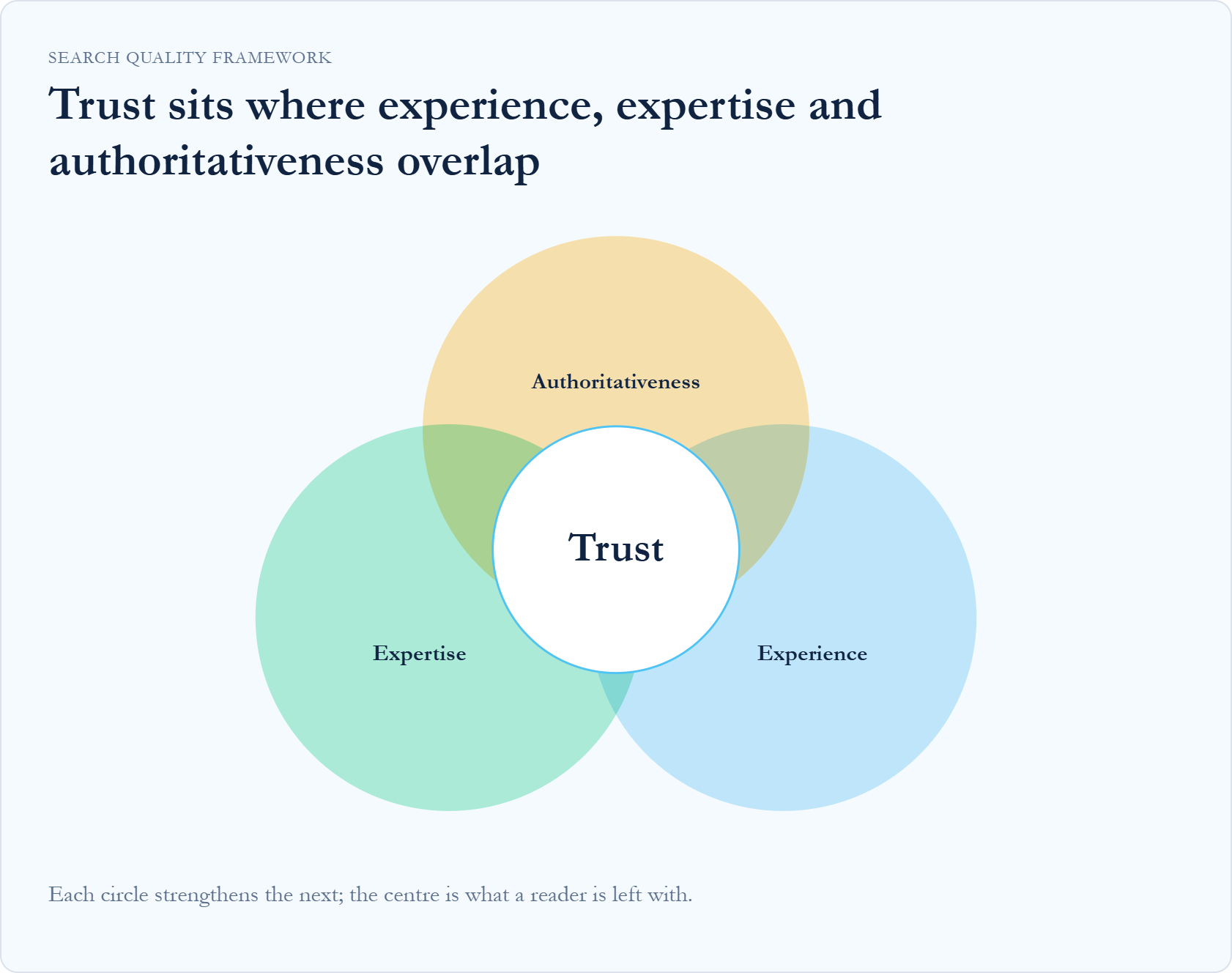
EEAT: The Framework That Was Always Going to Win
Google introduced E-A-T — Expertise, Authoritativeness, and Trustworthiness — in its Search Quality Rater Guidelines in March 2014.
Source: Page One Power (https://www.pageonepower.com/search-glossary/eeat)
Most people didn’t pay much attention at the time. It felt abstract. Then the Medic update in 2018 hit health and finance sites hard, and suddenly everyone wanted to understand what Google meant by expertise and trust.
In December 2022, Google expanded the framework by adding a second E for Experience, creating E-E-A-T. The addition was significant.
Source: Victorious
It drew a clear line between knowing about something and having actually done it. A product reviewer who used the product demonstrates Experience. A journalist summarising product specs from a press release demonstrates Expertise, but not necessarily Experience. That distinction matters enormously in an era when AI can generate plausible-sounding content about almost anything.
EEAT is not a score. It’s not a metric you can track in a dashboard. It’s a quality framework that shapes how Google evaluates the credibility of content and the people and organisations behind it. Pages with strong EEAT signals are 2.3 times more likely to be cited in Google AI Overviews, according to a Wellows study analysing 2,400 AI Overview citations.
That figure tells you something important: the quality framework Google built over a decade to evaluate human-written content is the same framework its AI systems use to decide what to cite. The rules haven’t changed. The stakes have.
The September 2025 update to the Search Quality Rater Guidelines expanded the YMYL (Your Money or Your Life) definition and added new evaluation criteria specifically for AI Overviews.
These are refinements to a framework that has been in continuous development for over a decade, not a new set of rules.
The State of AI SEO Search Right Now
Before deciding how to respond to AI search, it’s worth understanding the actual scale of what’s happening — because the figures are both more dramatic and more nuanced than most of the commentary suggests.
Google processed over 14 billion searches per day in 2024, compared to ChatGPT’s estimated 37.5 million daily search-like queries — meaning Google handled roughly 373 times more searches.
AI search is growing fast, but traditional search is not disappearing.
What is changing is how those searches resolve. Google AI Overviews appeared on 48% of all Google queries as of March 2026, up from 34.5% in December 2025. On local service queries, AI Overviews now appear on more than 80% of results. And 93% of Google AI Mode searches end without a click.
In Europe, the shift is real but more measured than in the US. Zero-click searches reached 59.7% of EU searches in 2025, and ChatGPT Search users in Europe jumped from 11.2 million to 41.3 million in early 2025 alone — a 270% increase.
But the decline in Google searches per searcher in the EU and UK between 2024 and 2025 was only 2 to 3%, compared to a nearly 20% decline in the US.
European audiences are shifting more gradually. The window for getting your strategy right is open, but it won’t stay open indefinitely.
There’s one further figure worth sitting with. AI search traffic converts at 14.2%, compared to Google organic’s 2.8% — roughly five times more valuable per session.
Source: Exposure Ninja via Fifty Five and Five
The volume is smaller, but the quality of traffic arriving from AI search is significantly higher. This is not a channel to ignore.
What Has Actually Changed: From Backlinks to Brand Mentions
This is where the genuine shift in AI SEO lies — and it’s worth being specific about what has and hasn’t moved.
Traditional SEO authority was built substantially through backlinks. The logic was straightforward: if credible sites link to you, you must be credible. An entire industry grew up around acquiring those links, sometimes by legitimate means, sometimes not. Google spent years trying to separate genuine authority signals from manufactured ones.
AI systems don’t read link graphs the same way. They’re trained on language. They understand brands as entities, built from patterns of mention, context, and co-occurrence across vast amounts of text. When an AI system generates an answer about, say, the best project management tools for remote teams, it draws on a training corpus that includes forum discussions, industry articles, reviews, podcast transcripts, and news coverage — not just a count of inbound links.
Ahrefs studied 75,000 brands and found that branded web mentions — linked or unlinked — correlate with AI Overview visibility at a Spearman coefficient of 0.664. Backlinks correlate at 0.218.
That’s a roughly 3x gap in favour of mentions. YouTube mentions showed the single highest correlation of all, at 0.737.
The practical implications of this are worth spelling out:
- 84% of AI citations come from earned media rather than a brand’s own website
- Brands are 6.5x more likely to be cited through third-party sources than through their own domains
- Earned media distribution can increase AI citations by a median lift of 239%
Source: Muck Rack, Airops, Stacker via Position Digital
Tim Soulo, CMO of Ahrefs, has called citations “the new backlinks” for the AI era.
Source: Ahrefs via Quattr
It’s a useful shorthand, though the underlying mechanism is different. A backlink was a technical signal. A brand mention is a credibility signal — built through genuine presence, not optimisation.
What this means practically is that getting your brand, your people, and your expertise talked about across the web matters more than ever. Guest contributions to industry publications, participation in relevant communities, founder thought leadership, strategic partnerships, and — for those with the resources — original research that others want to cite. These aren’t new tactics. They’re PR fundamentals applied to a new distribution model.
SEO and GEO: Why You Can’t Have One Without the Other
Generative engine optimisation — GEO — has become one of the more discussed terms in digital marketing over the past year. It refers to the practice of optimising content to appear as a cited source within AI-generated answers, rather than simply ranking in traditional search results. The difference between GEO SEO strategies and traditional SEO, put plainly, is this: SEO earns you a position on a results page. GEO earns you a position inside the answer itself.
Some businesses have begun to treat them as competing priorities. A handful have gone further and suggested that AI-powered SEO should replace traditional SEO entirely — that GEO is a separate discipline, built on different foundations.
The data doesn’t support that conclusion.
Every single article tracked in independent research between June 2025 and February 2026 that received AI citations had already earned organic Google rankings first. Not one piece of AI-cited content was ranking outside Google’s results entirely.
GEO without a strong SEO foundation is structurally weak. Google AI Overviews pull from pages that already rank in the top organic results for the query. Perplexity and ChatGPT favour sources with established credibility signals.
Companies doing solid SEO already capture meaningful visibility in AI answers, because the same EEAT signals that earn strong Google rankings are largely what AI systems use to decide what to cite. In that sense, doing SEO properly means you’re already doing a fair amount of GEO without realising it. But companies layering deliberate GEO techniques on top — things like structured data and active brand mention building — capture noticeably more of the available visibility, reportedly 60 to 70% according to industry estimates, compared with SEO alone. The reverse also holds true: GEO alone, without the infrastructure that solid SEO provides, doesn’t hold up.
The right way to think about seo and geo working together: SEO provides the foundation GEO builds on. Abandoning traditional SEO to chase GEO is like removing the ground floor of a building because you want to add another storey.
That said, applying genuine GEO techniques on top of solid SEO does make a meaningful difference. Research by Aggarwal et al. at Princeton and Georgia Tech — the team credited with coining the term GEO — found that applying optimisation techniques specifically for generative engine optimisation can boost visibility in AI-generated responses by up to 40%.
Total search volume, including AI-powered search, increased 26% worldwide in 2025. The opportunity is expanding, not contracting.
The brands that capture it will be those building both disciplines in parallel.
The Technical Side: What SEO for AI Engines Genuinely Needs
Most of what businesses need to do for SEO for AI search engines overlaps significantly with what good SEO has always required. But there are a handful of technical adjustments that carry more weight in an AI search environment.
Structured data has become infrastructure, not a nice-to-have
In March 2025, both Google and Microsoft publicly confirmed they use schema markup for their generative AI features. ChatGPT subsequently confirmed it uses structured data to determine which products appear in its results.
Pages with valid structured data appear 20 to 30% more often in AI-generated summaries than unstructured pages.
Only 12.4% of websites currently implement structured data.
That number represents a straightforward competitive advantage for those who act on it.
One important update worth flagging: Google deprecated FAQ Rich Results as a visible SERP enhancement in May 2026. The FAQ boxes previously appearing in search results are no longer generated. But FAQPage schema markup itself remains valuable as a trust signal for AI systems — the markup still matters, it simply no longer produces a visual feature in traditional search results.
Content structure matters more than it used to
Content with clean heading and question-and-answer structure earns AI citations at roughly 2.8 times the rate of unstructured prose, according to AirOps research.
AI systems need to parse and extract meaning quickly. A well-structured page with clear H2 and H3 headings, direct answers at the start of each section, and logically organised content is simply easier for both humans and AI systems to use. Queries of 8 or more words are 7 times more likely to trigger Google AI Overviews. This is the practical application of what people refer to as “chunking.”
Write for how people actually ask questions, not how they abbreviated them into two-word search queries a decade ago.
Beyond schema: the emerging technical checklist
Structured data and content structure are the two most established technical levers, but a handful of further signals are becoming increasingly relevant to AI SEO and worth building into any technical checklist:
- An llms.txt file — a file similar in concept to robots.txt, but aimed specifically at AI crawlers, telling systems like GPTBot and Claude-bot which parts of your site matter most and how your content is organised
- Strong crawlability and fast, accessible pages for AI bots — largely the same discipline as good technical SEO has always required: fast load times, clean server responses, sensible site architecture. The one real twist is that AI crawlers sometimes behave differently to Googlebot, so it’s worth checking server logs to confirm they can actually reach and fetch your pages, not just that Google can
- Visible freshness signals — clear publish and update dates, since AI answers skew heavily toward recent content
- Cross-platform corroboration — consistent mentions of your brand and claims across third-party sources, such as business listings, industry directories, review sites, and earned media coverage, so the model sees your claims confirmed independently, not just repeated on your own site
- Author schema linking to a credible, verified author profile with real credentials and a consistent publishing history
Creating genuine off-site mentions
Creating genuine off-site mentions starts with being present where your audience already is, rather than trying to manufacture citations artificially. Practical routes include contributing guest articles or expert commentary to trade publications and journalist request platforms, getting listed accurately and consistently on relevant business directories and review sites, participating substantively in industry forums and communities, and building relationships with complementary businesses for reciprocal mentions or joint content.
Consistency of your brand name and details across all of these matters more than volume. A handful of accurate, well-placed mentions on credible sites outweighs dozens of scattered, low-quality ones.
Using AI to Produce Better Content — Without Losing What Makes It Valuable
There’s an irony at the heart of the current conversation about AI SEO. The very technology disrupting search is also the most powerful tool available for producing the kind of content that ranks well within it.
The mistake most businesses make is reaching for one of two extremes. Either they avoid AI entirely, convinced it will produce generic, detectable content that damages their brand. Or they hand the entire content production process to an AI tool and wonder why the output feels hollow.
The smarter approach sits in between. AI handles the heavy lifting at the front end of the content process: research, data synthesis, structuring, outlining, generating infographic data sets, identifying statistical sources. The human effort then concentrates where it matters most — the polish, the authentic voice, the specific insight from genuine experience that no AI can replicate.
The efficiency gains from this approach are well documented. Organisations have reported cutting content production time by as much as 70% when AI is fully integrated into workflows.
Marketers save an average of 3 hours per piece of content when using generative AI tools. Workers using AI tools report average productivity increases of 40%.
But — and this matters — 91% of marketers actively use AI in their work as of mid-2026, yet only 41% can prove measurable ROI from it.
The difference between those two groups isn’t access to better tools. It’s having a clear system around how AI is used, what it’s responsible for, and where human judgement takes over.
The bottleneck in most organisations isn’t writing ability. It’s knowing how to structure an AI-assisted workflow, what to prompt, how to iterate, and how to build a process that’s repeatable rather than ad hoc. Once that process exists, the speed gains are real. Getting there takes investment — not in tools, but in thinking.
The Bigger Problem Most Businesses Aren’t Talking About
For many of the businesses worrying about AI SEO, the conversation is happening in the wrong order.
The debate about how to optimise for AI search assumes that content is being created in the first place. For a significant proportion of SMEs, that assumption doesn’t hold. Only 47% of B2B marketers have a documented content marketing strategy. Of those, 58% rate their strategy as only moderately effective. 24% of B2B marketers say they don’t have dedicated content teams or staff at all.
Source: Content Marketing Institute via Sales Genie ()
In the EU, 998 out of every 1,000 businesses are SMEs.
Content adoption barriers at small business level have an outsized effect on the overall market — and on individual businesses’ ability to build the kind of visibility that AI search rewards.
Any addition to the workload, even a more efficient one, is difficult to absorb when time and resources are already stretched. That’s the real barrier for most SMEs — not knowledge of GEO techniques or structured data schema, but the bandwidth to begin creating content consistently at all.
The business case for starting is stronger now than it has ever been. Small businesses are 23% more likely than average to see ROI from blog posts.
Source: HubSpot State of Marketing Report 2026
AI search makes content-based visibility more critical to long-term growth, not less — because being featured in an AI-generated answer depends on having content worth citing. You can’t optimise what doesn’t exist.
What the Businesses Getting AI SEO Right Are Actually Doing
The clearest pattern among businesses building genuine visibility in AI search is not that they’ve discovered some new tactical advantage. It’s that they’ve been consistently doing the right things in traditional SEO for years, and that foundation is now paying dividends in AI search visibility too.
They create content that is genuinely useful to a specific audience, backed by research and real expertise. They ensure their people are known — through bylines, podcast appearances, speaking slots, and consistent presence in the communities where their customers spend time. They invest in original data or tools that give others a reason to mention them. And they maintain the technical fundamentals: clean site structure, proper schema implementation, well-organised content with clear headings and direct answers.
None of that is new. What’s new is that the reward for doing it properly now extends beyond traditional search rankings into the AI-generated answers that an increasing proportion of your customers are receiving.
Only 16% of brands currently track their AI search visibility systematically. The other 84% are making decisions based on incomplete data.
For businesses that get serious about this now — both the traditional SEO foundation and the GEO layer built on top — the competitive opportunity is real, and it’s available to anyone willing to do the work properly.