
Results-Driven Website Design
AI Traffic is Better! Here’s why.
19 August 2026
Some of the most misleading metrics in website analytics are the “traffic” measurements. Visitors, sessions, users etc. These numbers have always been the most exciting to look at, and many business owners and CEOs see traffic as a north star. The problem is that in most cases, a lot of traffic is completely useless.
If you really want to know if your website is performing, you need to look past the on page metrics and understand how many sales, or leads your website is delivering.
To put it very simply, it’s better to have 100 visitors, converting at 10%, than 1000 visitors converting at 0.5%.
Adobe Digital Insights published its Quarterly AI Traffic Report in April 2026, drawing on more than a trillion visits to US retail sites, and the picture it paints of AI referred visitors is not what most marketers assume. These visitors are not just curious browsers poking around. They are often educated consumers or business decision makers who have landing on your website, ready to buy.
Twelve Months Ago This Was the Worst Traffic You Could Get
There’s no way to dress up how bad AI traffic looked in Adobe’s data at the start. Retail visitors arriving from AI assistants converted at roughly half the rate of everyone else in early 2025, and a non AI visit was worth 128% more in revenue. If you’d asked me then whether it deserved a line in a channel strategy, I’d have said watch it, don’t fund it.
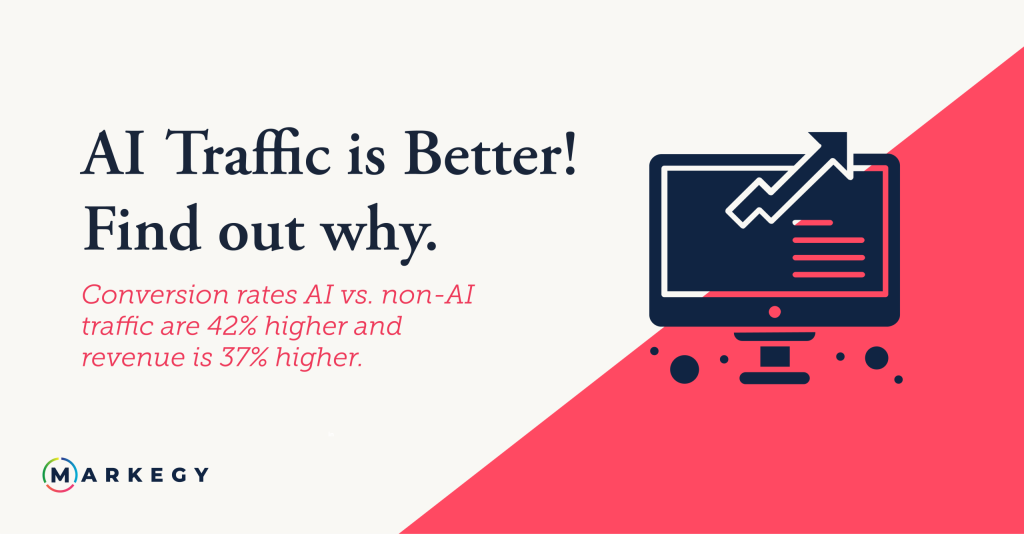
March 2026 tells a different story. The same cohort now converts 42% better than non AI traffic, and revenue per visit runs 37% ahead. Adobe describes the shift as AI assistants evolving from a browsing tool into a purchase driver, which sounds like press release language until you look at the supporting behaviour. Time per visit is 48% longer. Pages viewed per visit, 13% higher. And bounce rates have sat in a tight 17 to 20% band for over a year while non AI traffic hovers near 27%, which works out at AI visitors being 32% less likely to leave immediately.
Visitors are doing their research with AI, then landing on your website, ready to buy!
A visitor who was already walked through the options before clicking behaves like someone finishing a decision, not starting one. The data now shows that at trillion visit scale.
The Pattern Repeats Outside of Retail Too
Adobe tracks five industries, and the headline finding applies to all of them: AI referred traffic is more engaged, with lower bounce rates, everywhere they looked. Growth in Q1 2026 ranged from 63% year on year in tech and software (already the sector with by far the largest AI visit share, about four times retail’s) up to 393% in retail, with travel at 233%, financial services at 158%, and media and entertainment at 84%.
Travel deserves an honest footnote. It’s the one sector where AI conversions still trail non AI sources. But the gap has collapsed from 86% in October 2024 to 14% in March 2026, and AI referred travellers spend 61% more time on site while bouncing 41% less. I wouldn’t bet on that gap surviving the year.
The Consumer Side Explains It
Adobe paired the traffic data with a March 2026 survey of over 5,000 US consumers, and the answers line up neatly with the behaviour. Some 39% have now used an AI assistant for online shopping. Of those, 79% say they feel more confident in a purchase afterwards, and 69% reckon they’re less likely to return something bought with AI’s help. Half click the links the assistant gives them; 27% buy directly through those links.
Fewer returns is the detail retailers should sit with, because return rates quietly eat ecommerce margins in a way top line conversion figures never show.
What This Means for SaaS and B2B
If anything, the retail numbers understate the case for software and B2B companies. Tech and software already holds the largest AI visit share of any sector Adobe tracks, roughly four times retail’s, and its visitors show the widest quality gap of all: 30% higher engagement than non AI traffic, a bounce rate 40% lower, 40% more time on site and 23% more pages per visit. Adobe’s survey adds the buying context, with 47% of consumers now using AI to research or troubleshoot tech products and 21% having made a tech or software purchase with AI’s help.
The B2B specific benchmarks are stronger still. The Opollo 2026 AI Search Benchmark Report, covering 312 B2B technology firms across North America, Australia and the UK, put AI referred conversion at 14.2% against 2.8% for Google organic.
That gap makes intuitive sense once you consider how B2B buying actually works. A software evaluation involves comparison, shortlisting and a fair amount of anxious reading, and that is precisely the work an AI assistant now does before the click. For a SaaS business with a long consideration cycle, the assistant is quietly replacing the middle of the funnel, which means the visitor landing on your pricing page from ChatGPT may be further along than one arriving from a paid search ad you paid handsomely for.
So What Are the Winning Brands Doing?
Adobe scored retailers on what it calls citation readability, essentially how easily an AI system can parse and surface a page’s content. The brands with the highest AI visit share beat the bottom group by 52% on homepage readability, 32% on search pages, and somewhere between 23 and 30% on blogs and buying guides. They also carry noticeably fewer content gaps on their high traffic pages.
None of that is radically new. Structured pages, complete information, clear context. The same discipline good SEO has always demanded, now with a second audience reading it. On the organic comparison specifically, Semrush’s study of over 500 topics found AI search visitors converting at 4.4 times the rate of traditional organic visitors, so the pattern isn’t unique to Adobe’s dataset.
AI referrals are still a small slice of total sessions for most sites
The usual caveat applies: AI referrals are still a small slice of total sessions for most sites, and vendor data always deserves a raised eyebrow. Neither point changes the practical conclusion. A channel growing at triple digit rates in every industry, sending the best behaved visitors in your analytics, is worth measuring properly before your competitors notice it exists. Split it out from direct traffic, judge it on revenue per visitor, and make the pages you’d want cited actually readable to the systems doing the citing.